
Understanding UK Betting Odds: Essential Horse Racing Terminology
The first time an American friend asked me what "eleven to four, on the nod" meant, I realised how foreign British racing vocabulary sounds to anyone raised on parimutuel pools and dollar bets. He thought I'd quoted a poem. In fairness, I had — the rhythm of fractional odds, the cadence of SP, the rolling consonants of Lucky 15 and Yankee, these are the verse of an old British trade, and they confuse outsiders because they were never built for them.
Twelve years inside this market and I still meet seasoned punters who can place a six-fold accumulator but cannot tell you why each-way splits down the middle, or what Best Odds Guaranteed actually obliges a bookmaker to pay. The terminology carries pricing logic, regulatory history, and the friction between three parallel markets that operate at the same racecourse on the same afternoon — the on-course ring sets a Starting Price, the Tote runs a parimutuel pool, Betfair's Exchange runs a peer-to-peer order book. Every term you'll meet is a passport stamped by one of these three. Remote betting yield on horse racing reached £766.7 million in the year to March 2025, on a base of 59 licensed racecourses and an industry worth around £4.1 billion a year to the British economy.
This is not an A-to-Z list. I've written enough of those to know they are the wrong shape for how punters actually learn. I'll walk you through the vocabulary in the order it appears in real betting life — odds grammar, price formation, bet structures, pools, the physical card, what happens between declaration and weighed-in, market movement, and the regulatory and black-market layer reshaping how British bettors now talk.
Five Things This Glossary Will Settle For You
- British racing prices come in three flavours — fixed-odds, Tote pool and Exchange — and most terms you'll meet belong to one of them.
- Fractional odds are still the working dialect on the racecard and the screen; decimal is a calculator's convenience, not a British habit.
- Each-way is one bet behaving as two halves, and the place fraction changes by race type — Sky Bet paid 7 places at 1/5 on the 2026 Grand National, with Bet365's Each Way Extra stretching to 10.
- The effective tax on a British racing bet is 25 percent — 15 percent General Betting Duty plus a 10 percent Levy — and that arithmetic explains half the regulatory vocabulary you now hear.
- Affordability checks bite at £150 net deposits a month, which is why the words "frictionless", "black market" and "single customer view" entered the betting tongue in 2025.
The Grammar of British Prices
I once watched a Belgian colleague stare at a Racing Post racecard for a full minute before asking why the column of numbers on the right looked like fractions of an inch. He was looking at 11/4 and trying to convert it in his head — he'd grown up with decimals, as most of Europe has. Britain, with the obstinacy that defines a great many of its sporting habits, kept fractions. You need three concepts to read every price on this island: what a fraction tells you, what stake and return mean inside that fraction, and which of the three British markets issued the price.

Fractional and Decimal Odds, Side by Side
A fractional price such as 11/4 reads as "for every four units staked, you win eleven." A £4 win-only bet at 11/4 returns £15 — £11 profit plus the £4 stake. The same price as a decimal is 3.75, which folds stake and profit into one figure. Both are correct. Britain still defaults to fractions on the racecard, on the Tote board, and on the bookmaker's screen in the betting shop. Evens is 1/1; odds-on means the bookmaker is offering less than your stake in profit; long odds describe anything paying substantially more than the stake.
Stake-and-return at three common prices
£10 at 4/1 (decimal 5.0): profit £40, total return £50.
£10 at 11/4 (decimal 3.75): profit £27.50, total return £37.50.
£10 at evens (decimal 2.0): profit £10, total return £20.
Stake, Profit, Return — Three Words That Aren't Synonyms
British punters do not use these words loosely. Stake is what you risk. Profit is what you win on top. Return is stake plus profit. The distinction matters the moment Rule 4 deductions or Tote dividends enter the picture, because those operations work on the profit, not the return. When a tipster says a horse is "7/2 the field", he's talking about implied probability — 7/2 implies the bookmaker thinks the horse wins about 22 percent of the time, once you strip out the over-round.
Three Markets, One Race
This is the single most important distinction in British racing. A 3.30 at Doncaster is being priced three separate times in three separate venues, simultaneously.
Fixed-odds
The price you take now is the price you're paid at. Offered by sportsbooks and on-course bookmakers. The Starting Price is the formal closing fixed-odds benchmark.
Tote
Pool betting. All stakes go into one pool; winnings are shared among winners after a deduction. The dividend is only known after the off.
Exchange
Peer-to-peer. You either back a horse or lay it. Prices set by the order book; the closing BSP is a calculated auction price from final pre-race volumes.
Most casual British punters live in fixed-odds. Most weekend Tote players come for the Placepot. Most Exchange users are matched-betting refugees or self-styled traders. Starting Price and Best Odds Guaranteed sit firmly inside fixed-odds; BSP sits inside the Exchange; Placepot lives inside the Tote. The Gambling Commission's 24.4 million active accounts across remote casino, betting and bingo in 2024/25 still default to fractional on UK racing.
Starting Price, and the Prices That Outrank or Undercut It
Ask a sample of British racing fans what the Starting Price means and a fair number will say "the price on TV when the race starts." Close, but not quite. SP is a returned price, calculated after the off from a sample of on-course bookmakers in the betting ring at the very moment the horses set off. It is the industrial benchmark — every bookmaker in the country settles their "SP" bets against this number — and it anchors the entire fixed-odds market. Around SP cluster three commercial prices: the early board price, Best Odds Guaranteed, and BSP, the Betfair Starting Price calculated on the Exchange.
How SP Is Derived
The mechanics are unglamorous and rigorous. A representative sample of on-course bookmakers is observed at the moment of the off; their prices are aggregated by the SP Regulatory Commission, which uses a weighted median rather than a simple average so aberrant prices don't drag the returned figure either way. Because SP is sampled from the ring rather than an online order book, it is exposed to on-course liquidity. Big handicap days produce robust samples; a wet Tuesday at Sedgefield, with three bookmakers in the ring instead of fifteen, produces a thinner one — which explains why SP and the bigger online early prices occasionally disagree by half a point.
Best Odds Guaranteed, and Why It's Shrinking
BOG is the commercial promise that the bookmaker who took your morning bet will pay the bigger of two prices — the early price you took or the SP that's returned. It cost operators very little when betting margins were robust; it costs them more when margins are thin, which is most of why BOG has been quietly carved back over the past two years. By 2026 it is a moving target — some firms restrict it to win-only singles, some apply it only after a certain time of day, some have withdrawn it from "restricted" accounts entirely. Anne Lambert, Interim Chair of the Horserace Betting Levy Board, put the structural shift bluntly — she warned that "bookmakers' increased profits are being generated from falling turnover," a tension that explains the steady contraction of generous promotions like BOG across the British market.
BSP — The Exchange Equivalent
The Betfair Starting Price is a different animal. Instead of sampling a ring of physical bookmakers, BSP is calculated from matched volumes in the Exchange's pre-race auction. At the off, the order book is closed and an algorithm balances back and lay liquidity to produce a single closing price for each runner. BSP and SP are not the same number, although they're usually close on liquid markets; BSP frequently shades higher than SP on outsiders, because Exchange liquidity tends to underprice longshots relative to the on-course ring. The detail of how SP is built and where BOG is being quietly withdrawn belongs in a dedicated piece — Starting Price and Best Odds Guaranteed goes into the Regulatory Commission's methodology and the current operator-by-operator state of BOG in full.
Each-Way: One Stake, Two Bets, Three Common Confusions
Here is the most common mistake I see at the Aintree gantries, and not only among first-timers. A punter steps up to the on-course bookmaker, says "fiver each-way the favourite", hands over a five-pound note, and walks away. The bookmaker calls him back — the total stake on an each-way bet is twice the unit stake, because each-way is two bets, not one. Once you understand that each-way is a doubled structure with a place fraction attached to the second half, the rest of British place-terms vocabulary falls into place.

How Each-Way Splits
An each-way bet is one ticket with two distinct halves. Half of your stake is the win portion — paid only if your horse finishes first. The other half is the place portion — paid if your horse finishes inside a specified number of places, at a fraction of the win odds. The most common fractions are 1/4 for non-handicaps and 1/5 for handicaps. A "£5 each-way" bet has a total stake of £10. If the horse wins, both halves pay; if it places without winning, only the place portion settles.
£5 each-way at 12/1, 1/5 odds, 4 places
Total stake: £10. Horse wins: win half pays £5 × 12/1 = £60 + £5 stake; place half pays £5 × (12/5) = £12 + £5 stake. Total return: £82.
Horse places (2nd, 3rd or 4th): win half loses. Place half pays £5 × 12/5 = £12 profit + £5 stake = £17 return on the £10 total stake.
Place Fractions, and Why They Change
The place fraction is a feature of the race, not the bet. Non-handicaps with small fields traditionally pay at 1/4 over 2 or 3 places. Handicap races, larger and harder to call, default to 1/5 over more places. The bigger the field, the more places the standard terms cover; the bigger the race, the more places bookmakers will offer as a promotion. This is where "extra places" enters the British betting tongue.
Extra Places — The Promotional Edge
Extra places are voluntary upgrades by individual bookmakers above the standard each-way terms for a specific race. The Grand National is the high-water mark every spring. In 2026, Sky Bet paid out on 7 places at 1/5 odds on the National, while Bet365's Each Way Extra promotion stretched payouts up to 10 places on the same race. The Grand National attracted a forecast £200 million in betting turnover in 2025, with the full Aintree festival pulling closer to £250 million. The place-terms war is one of the principal weapons by which major bookmakers compete for that liquidity. One quirk worth noting: the place fraction on the National's extra places is usually 1/5 even though it's a handicap and you'd expect 1/4 — bookmakers extend depth (more places) rather than fraction, because depth is what casual punters notice. The operator-by-operator picture for the world's most-bet handicap belongs in the dedicated piece on Grand National each-way places.
Multiples: When One Slip Carries Many Bets at Once
Saturday lunchtime, ITV racing on the screen, a four-fold on the slip, and someone in the next chair shouts "go on the second leg." The multiples bet is the social currency of British weekend racing, and the most mathematically unforgiving structure on the slip.
Doubles, Trebles and Accumulators
The simplest multiple is a double: two selections, both must win. Returns from the first horse roll onto the second, which is why a 4/1 and a 3/1 double pays at (4+1) × (3+1) − 1 = 19/1. A treble adds a third leg on the same compounded logic; an accumulator is anything from four legs up. The word "fold" is British shorthand for the number of selections. One losing leg sinks the whole bet.
Lucky 15, Lucky 31 and Lucky 63
This is the family of full-cover bets with singles. A Lucky 15 is four selections covering 15 separate bets — 4 singles, 6 doubles, 4 trebles, 1 four-fold. The point of the Lucky family is that one winner still produces a return — your single pays. Most bookmakers add a bonus: a single winner on a Lucky 15 typically pays at treble the odds, and all four winners pulls a bonus of 10 to 20 percent on the total. The Lucky 31 adds a fifth horse (31 bets); the Lucky 63 covers six horses across 63 bets.
Yankee, Heinz, Super Heinz, Goliath
This is the same family without the singles. A Yankee is four selections in 11 bets — 6 doubles, 4 trebles, 1 four-fold. You need at least two of your four to win for anything to come back. A Trixie is the three-selection version: 4 bets, two-winner minimum. A Patent is the three-selection version with singles: 7 bets, one-winner return. From here the names get hungrier: a Canadian is five selections in 26 bets; a Heinz is six selections in 57 bets — named, the old joke goes, after the number of varieties; a Super Heinz is seven in 120; a Goliath is eight in 247. At a £1 unit stake a Goliath costs £247 win-only, doubled to £494 each-way. For the bonus mechanics worked through with stake examples, the dedicated piece on UK multiples bets takes the maths apart bet by bet.
Pools, Placepots and the Quiet Persistence of the Tote
An old colleague of mine refuses to bet anything other than the Tote. He likes the lack of pretence — no advertised price, no morning hype, just a pool, the deductions taken off the top, and the dividend declared after the off. Pool betting in 2026 is a minority sport in Britain, but it remains the natural home of one of the country's most popular weekend bets — the Placepot — and its own vocabulary that fixed-odds players misread routinely.

Placepot, Jackpot, Quadpot
The flagship Tote bet for the British midweeker is the Placepot: pick a horse to be placed in each of the first six races on a chosen card. The Tote pools every stake, deducts a take, and divides what remains among winning units. The advertised price is unknowable in advance — it's a dividend, declared after the sixth race, and it changes every meeting depending on stakes, runners and favourites' luck. The Jackpot is a stricter cousin: pick the winner of each of six nominated races. Miss one and you're out. Quadpot covers races 3 to 6 of a card, designed for punters joining a meeting in mid-afternoon.
Dividend, Not Price
This is the conceptual gap fixed-odds players need to bridge. A Tote dividend reflects what is left in the pool after deductions, divided by the number of winning units. It is a price discovered, not a price quoted. A 50/1 outsider winning a six-runner pool with hundreds of small stakes on the favourite returns a vastly larger dividend than the same horse winning a heavily-bet handicap.
£2 perm on a six-race Placepot
Two horses in each of six races: 2 × 2 × 2 × 2 × 2 × 2 = 64 lines. Total stake at £2 per line: £128. If all six selections place, your 64 winning units share the declared Placepot dividend; the operator's deduction has already been taken before the dividend is set.
Britbet, the Tote and What Happened in 2019
For seventy years, "the Tote" in Britain meant a single state-owned pool-betting monopoly. The Horserace Totalisator Board was privatised in 2011, sold on in 2018, and merged in 2019 with Britbet — the rival pool-betting operation owned by 55 of Britain's racecourses. The merged entity now operates as Tote, with the racecourses retaining a substantial stake. Tote pool turnover is a fraction of fixed-odds turnover in Britain, but pool betting survives because the Placepot remains an inexpensive, sociable, accumulator-style game for the £2 weekend punter. For the dividend mathematics, deduction percentages and rollover mechanics, the dedicated piece on UK Tote pool betting takes that arithmetic to its proper depth.
Going, Surface and the Card — How the Physical Day Is Described
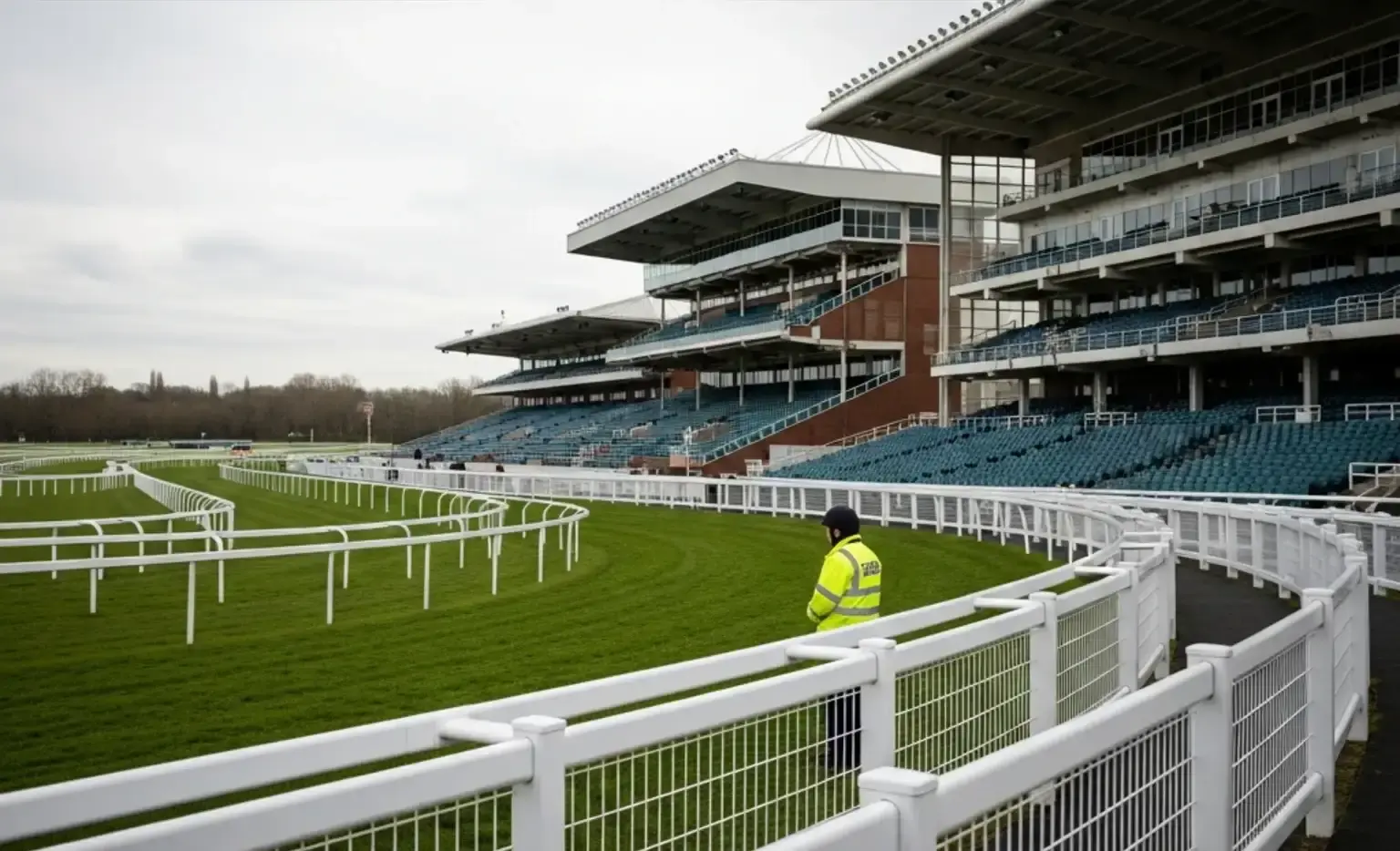
Walk the course at Cheltenham on a Wednesday morning in March and you'll see a man in a high-vis jacket pushing what looks like a heavy-duty walking stick into the turf at regular intervals. That's the Going Stick, a Turftrax penetrometer that measures the resistance of the ground to a vertical force. Its number, alongside the clerk-of-the-course's traditional verbal assessment, is what produces the word printed on every racecard that afternoon. "Going" is the most British of racing terms — a single word doing more work than any other on the card, shorthand for ground condition, implied speed, the type of horse who'll relish it, and suitability for jumping versus flat.

The Going Scale, Heavy to Firm
British going runs on a seven-step scale. From wettest to driest: Heavy, Soft, Good to Soft, Good, Good to Firm, Firm, and the very rare Hard. All-weather racing uses a parallel three-step scale: Slow, Standard, Fast. The going stick reading gives a numeric anchor — 5.0 to 5.5 is Good, below 4.5 is Soft, below 4.0 is Heavy.
Heavy / Soft
Wet, slow ground. Favours stamina horses and proven mudlarks. Jump fields contract on softer ground.
Good to Soft / Good
The benchmark riding. Most form lines apply at face value. The default ground at most British fixtures.
Good to Firm / Firm
Fast, dry ground. Favours speed horses. Increases injury concern at jump fixtures.
Turf, All-Weather and the Surface Map
Most British racing is run on turf. All-weather racing uses a synthetic surface — Polytrack, Tapeta or Fibresand — and runs through the winter, when turf cards are vulnerable to frost. Britain has 5 all-weather tracks: Chelmsford, Kempton, Lingfield, Southwell and Wolverhampton; Dundalk in Ireland is the sixth track on the British circuit's effective all-weather map. The all-weather surface produces less variable going and faster, more consistent times.
The Racecard, Decoded
A British racecard carries a dense set of symbols. CD means the horse has won at this Course and Distance; C alone means course-winner only, D alone, distance-winner only. BF is "beaten favourite". Weight is shown in stones and pounds (9-7 = 9 stones 7 pounds). Form figures to the left of the name read right-to-left in chronological order: 1 is a win, 2 to 9 the finishing position, 0 means outside the top nine, F is fall, U is unseated, P is pulled up, R is refused. Race distance is given in furlongs (one furlong = 220 yards) and miles — a "five-furlong sprint" is the shortest flat distance commonly run; the Grand National is the longest at four miles two-and-a-half furlongs.
What Happens Between Declaration and Weighed-In
A bet placed on Friday night is not the same animal as a bet placed two minutes before the off. Between the moment you click the button and the moment "weighed-in" is announced, your slip passes through a corridor of regulatory machinery — most of it you'll never need, some of it capable of changing your return without warning.
Declaration, Non-Runners and the Slip Before the Off
Horses are declared to run typically 24 to 48 hours before a race. A horse that's been declared and then withdrawn becomes a non-runner — abbreviated NR on the racecard, sometimes NS if withdrawal occurs at the stalls. Stakes on a non-runner are returned in full on win-only markets. The complication is what happens to the rest of the market — the bookmaker's book is left unbalanced, and the industry applies Rule 4 to restore it.
Rule 4 — The Tattersalls Deduction
Rule 4(c) of the Tattersalls Committee on Betting governs how bookmakers adjust prices when a runner is withdrawn after the market has formed. The deduction is taken from the winnings, not the stake, expressed in pence-in-the-pound, and it's sliding — the shorter the price of the withdrawn horse, the bigger the deduction on every other horse in the race.
Rule 4 worked example
Stake: £10 win-only at 5/2. Potential winnings before Rule 4: £25. A 30p in the pound deduction applies. Adjusted winnings: £25 × (1 − 0.30) = £17.50. Total return: £27.50, instead of £35. SP bets don't see a separate deduction — it's already baked into the post-withdrawal SP.
Photo Finish, Dead Heat, Stewards' Enquiry
If two horses cross the line inseparably, the judge calls for a photo finish — a digital line-of-sight image triggered at the post by an infrared beam. If the photo cannot separate them, the judge declares a dead heat and the stake on each affected horse settles on a half-stake basis at full odds. A Stewards' Enquiry is convened when an incident in running warrants formal review; the result is provisional until "weighed-in, weighed-in" is announced over the Tannoy.
One contemporary marker worth knowing: the race-on-time rate — percentage of races starting within two minutes of their scheduled off — was 82.2 percent in 2025, up from 79.2 percent in 2024 and 72.7 percent in 2023. Punctuality reform directly affects when SP is set, when in-running Exchange markets close, and when BOG cut-offs activate.
The Language of a Moving Market
If you've ever watched the boards in the last twenty minutes before a 2.30 at Newmarket, you'll have heard the language change rhythm. "Drifting." "Gone short." "Steamer." "Walked in." These are trader's idiom, the working slang of people watching liquidity move before the off — and they're some of the most useful words in the British betting tongue, because they describe behaviour, not state.
Drifter, Steamer, Jolly
A drifter is a horse whose price is getting bigger as the off approaches — money leaving the horse, or none coming in fast enough to support the early price. A steamer is the opposite — heavily backed, price contracting visibly. The jolly is the market favourite, cockney shorthand for "jolly old favourite" abbreviated decades ago. An outsider is anything at 16/1 or longer, though some traders draw it at 20/1 or 25/1.
Drifter — a horse whose price is lengthening in the run-up to the race. The opposite of steamer.
Steamer — a horse whose price is contracting on heavy support. Sometimes signals stable confidence or insider money.
Jolly — the market favourite, head of the book at any given moment.
Smart Money, Money-For, Friendless
"Smart money" is slang for stakes thought to be informed — stables, work-watchers, syndicate insiders. The phrase is overused; real smart money is rarely identifiable in advance. "Money-for" is more honest — "there's been money for the second favourite" simply means the prices have moved without speculation about who moved them. A friendless horse is one no one in the ring is backing — the price drifts because no one is supporting it, and the drift itself becomes a signal others act on.
The most evocative dead language in British racing is tic-tac — the hand-signal code on-course bookmakers used to communicate prices across the ring before mobile phones killed it off. "Carpet" meant 3/1, "Burlington" meant 9/1, "double carpet" meant 33/1. You'll still see veterans in the Aintree ring flashing a few signs out of habit.
The Regulatory Words That Didn't Exist Five Years Ago
When I started writing about this market in 2014, the regulatory vocabulary you needed to follow British racing fitted on a postcard: Gambling Commission, BHA, Levy. The corpus a UK punter is now expected to navigate has tripled in five years, and most of the new words have a sharp edge — affordability check, Single Customer View, Financial Risk Assessment, Source of Funds. They are the words your bookmaker uses when your account is being reviewed.
Affordability Checks
An affordability check is the Gambling Commission's mechanism for assessing whether a punter's spend is sustainable given their financial circumstances. As of February 2025, the formal pilot threshold for what the Commission calls a "light-touch financial vulnerability check" is £150 in net deposits per calendar month. Below that line, the operator runs frictionless background checks against credit reference data; above it, deeper scrutiny may apply, including the more invasive Financial Risk Assessment. The threshold is per operator, per month, net of withdrawals — for a regular weekend punter staking £20 or £30 a Saturday, the line gets crossed in any active month. The Racing Post Big Punting Survey reported that 23.7 percent of British bettors had passed through some form of affordability check by the start of 2025, up from 16.6 percent in 2023. Brant Dunshea, the BHA's Acting Chief Executive, has been blunt — the underlying data is "a further reminder of why it's important for gambling regulations to be both balanced and proportionate, with those who are betting safely on racing allowed to do so without interruption." For the full mechanics, the dedicated piece on UK gambling affordability checks walks through it step by step.
Single Customer View and Financial Risk Assessment
The Single Customer View (SCV) is an industry framework intended to let operators share, in anonymised form, indicators of harmful gambling across customer bases — so a punter showing problem signals with one operator can be identified before opening a fresh account with another. Piloted across major UK operators since 2024, it's one of the most contested elements of the new landscape. The Financial Risk Assessment (FRA) is the deeper, evidential check applied to higher-spending accounts — where the £150 light-touch is a background data lookup, an FRA can require pay slips, bank statements or documentary proof of source of funds.
The Levy, GBD and the Effective 25 Percent
Two parallel imposts sit on a British racing bet. The General Betting Duty (GBD) is HM Treasury's 15 percent tax on the bookmaker's gross profit. The Horserace Betting Levy (HBL) is a separate 10 percent levy ring-fenced for the racing industry. Stacked, they produce an effective 25 percent tax on the betting industry's racing profit. Total Levy receipts for 2024/25 were £108.9 million — the highest since the 2017 reform — with HBLB directing £66.9 million to prize money, £19.4 million to regulation and integrity, £7.9 million to staff and retraining, and £2.3 million to veterinary research. One more reform to keep in your vocabulary: Remote Gaming Duty (RGD), the parallel tax on online casino, rises from 21 percent to 40 percent on 1 April 2026. RGD applies to casino, not racing, but the asymmetric increase has reshaped the commercial calculus inside every multi-vertical UK operator.
The Vocabulary the Black Market Brought With It
A regulator-aware vocabulary has emerged in British betting since 2023 and it is, frankly, ugly. Parasite operator. Leakage. Offshore. Unlicensed. Five years ago these were footnote terms; now they sit in every senior industry briefing. The IFHA reported that unique UK visitor traffic to 22 unlicensed racing-betting sites rose by 522 percent between August 2021 and September 2024. The H2 Gambling Capital study commissioned by the Betting and Gaming Council found offshore betting turnover from UK customers grew from £5 billion in 2019 to £16.6 billion in 2025, with the legal sector's share of UK gambling falling from 97 percent in 2019 to 92 percent in 2025.
Grainne Hurst, Chief Executive of the BGC, has been the most vocal industry voice on this trend, describing unlicensed operators as "parasite operators" that "don't pay tax, don't care about safer gambling, and do not contribute a penny to the levy." The Racing Post Big Punting Survey found 4.9 percent of British bettors had used unlicensed bookmakers in 2025, up from 3.6 percent in 2023 — and among self-described high-stakes punters, the figure rises to 33 percent. Of those who'd crossed to unlicensed operators, 63.6 percent cited affordability checks as the principal reason.
The terms you'll meet most often: offshore (operator based outside the UK regulatory perimeter), unlicensed (no UKGC remote operating licence), leakage (the migration of UK punters from licensed to unlicensed sites), parasite operator (BGC's preferred pejorative), and frictionless (used by industry as the property the £150 check is meant to deliver and is widely felt to fail at).
The Vocabulary of the Big Three: Cheltenham, Aintree, Royal Ascot
Three festivals dominate the British racing calendar and three festivals carry their own dialects. A casual punter who bets only on Grand National day uses a vocabulary measurably different from a Cheltenham four-day attendee, and a Royal Ascot regular uses something different again. The terminology is not interchangeable, because the racing isn't.

Cheltenham Festival
Four days in March. National Hunt racing. Forecast £450 million in betting turnover for 2026. Signature races: Champion Hurdle, Queen Mother Champion Chase, Stayers' Hurdle, Gold Cup.
Grand National (Aintree Festival)
Three days in early April. National Hunt steeplechasing. Approximately £200 million in betting turnover on the Saturday National alone in 2025. Signature race: the Grand National.
Royal Ascot
Five days in June. Flat racing. Average daily attendance of 54,984 between 2022 and 2025. Signature races: Gold Cup, Diamond Jubilee Stakes, King's Stand, Queen Anne.
Cheltenham — National Hunt Vocabulary
Cheltenham is a jumps festival, which means the vocabulary draws from National Hunt — racing over fences and hurdles, in contrast to flat. The first race at every Cheltenham fixture used to be a Bumper, a National Hunt Flat race for unraced or lightly-raced horses, designed to give jumpers a competitive run before they start jumping. The week's signature races each have unique terminology: the Gold Cup is a three-mile chase for top-class staying chasers; the Champion Hurdle, the two-mile hurdle championship; the Queen Mother Champion Chase, the two-mile chase championship. Optimove data showed 68.8 million individual bets were placed on Cheltenham 2025 across the major operators, with the average stake on Gold Cup day 109 to 133 percent higher than the baseline. William Hill spokesperson Lee Phelps captured the trade view: "the battle between us and the punters over the four days of the Cheltenham Festival is unrivalled in Jumps racing. We're expecting around £450 million to be wagered over the four days."
Grand National — The Casual Punter's Day
The Grand National's vocabulary is shaped by its casual audience. National fences, with their distinctive names (Becher's Brook, The Chair, Foinavon, Canal Turn), have a folklore status no other course in Britain shares. The maximum field size was reduced from 40 to 34 runners from 2024 as part of the post-2023 safety reforms. Around 30 percent of National 2025 punters were either first-time depositors or first-time bettors since the previous year, which is why the National is the largest single recruitment event for UK bookmakers each season. Roughly 50 percent of total National revenue comes from stakes of £5 or less, and the race attracts roughly seven times more bets than the Cheltenham Gold Cup — the closest thing British sport has to a national punt.
Royal Ascot — Flat Racing's Set-Piece Vocabulary
Royal Ascot is the flat-racing equivalent and has its own vocabulary stack. Flat racing distinguishes between Group races (the elite international classifications: Group 1, 2, 3) and Listed races just below. Flat's classics are limited to specific age groups — the 2,000 Guineas and 1,000 Guineas at Newmarket are for three-year-olds, as is the Derby at Epsom, the Oaks for three-year-old fillies, and the St Leger at Doncaster. The vocabulary leans on words like handicap, conditions race, maiden (a race for horses that have not yet won) and weight-for-age, which describe entry conditions rather than prize structure.
A Quick Reference, Built Like a Crib Sheet
The terminology above is best learned in the order presented — by market, then by phase of a bet's life. But you'll occasionally want a short reference you can scan in twenty seconds. Here it is, alphabetical and condensed.
Ante-post — a bet placed before final declarations, well in advance of the race. No stake refund if your horse doesn't run, in exchange for a typically bigger price.
BOG — Best Odds Guaranteed. Pays the bigger of your early price or the returned SP. Promotional, increasingly carved back.
BSP — Betfair Starting Price. The Exchange's closing auction price, calculated from final pre-race volumes.
Bumper — National Hunt Flat race, the entry-level race-type for prospective jumpers.
Drifter — horse whose price is lengthening before the off. Opposite of steamer.
Each-way — one bet in two halves: win plus place. Total stake is doubled.
Going — the state of the racing surface, from Heavy through Soft, Good and Firm.
Handicap — a race where horses carry weights set by the handicapper to equalise their chances.
Jolly — the market favourite.
Maiden — a race for horses that have never won.
NR / NS — non-runner / not started. Stake returned on win-only markets; remaining horses subject to Rule 4.
Placepot — Tote pool bet covering the first six races on the card; pick a placed horse in each.
Rule 4 — Tattersalls deduction applied to winnings when a horse is withdrawn after market formation.
SP — Starting Price. The industry benchmark returned price, set by the SP Regulatory Commission from a sample of on-course bookmakers at the off.
Void — bet cancelled; stake returned. Most often applied to abandoned meetings or non-runners.
Yankee — four selections in 11 bets: 6 doubles, 4 trebles, 1 four-fold.
Before you place a bet, run through this
- Check the going against the form of your horse.
- Look at the trainer's recent strike rate, not just the horse's last three runs.
- Confirm the course type — turf or all-weather — matches the horse's preference.
- Read the place terms on each-way bets before you click. They vary by operator and by race.
- Confirm whether Best Odds Guaranteed applies to your account, your bet type and the time you placed.
- If a horse is withdrawn between bet placement and the off, expect a Rule 4 deduction on winnings.
Questions Punters Actually Ask
I've been asked variations of these questions, in pubs and on press days, for the better part of a decade. The short, direct answers are below.
What is an each-way bet in UK horse racing?
One ticket placed as two bets — half your stake on the horse to win, half on it to place. So "£5 each-way" costs £10 in total. The place half pays at a fraction of the win odds (1/4 on non-handicaps, 1/5 on handicaps) if the horse finishes within the bookmaker's stated places. If the horse wins, both halves pay; if it places without winning, only the place half pays.
What does Starting Price (SP) mean and how is it calculated?
SP is the official returned price for a horse at the moment of the off. The SP Regulatory Commission calculates it from a representative sample of on-course bookmakers in the ring, using a weighted median to reject outliers. The figure is transmitted via the Press Association feed and every "SP" bet anywhere in the country settles against it. SP is distinct from BSP, the Exchange's auction-calculated equivalent.
What is the difference between fractional and decimal odds in the UK?
Fractional odds (11/4) express profit relative to stake — 11 units of profit for every 4 staked. Decimal odds (3.75) express total return. Both are correct and interchangeable. The racecard, the Tote board and the betting shop default to fractional; many online interfaces offer both.
What is Best Odds Guaranteed (BOG) and which bookmakers still offer it?
BOG is the promise that if you take an early price on a UK or Irish race and SP returns bigger, the bookmaker pays the bigger of the two. It costs the operator margin, so it has been progressively restricted — some firms now apply BOG only to win singles, others to specific time windows, and many have removed it from restricted accounts. Read the BOG terms on your operator before assuming the headline promise applies to your bet.
How does Rule 4 deduction work?
Rule 4 of the Tattersalls Committee on Betting governs how bookmakers adjust prices when a horse is withdrawn after the market has formed. The deduction is taken from winnings, expressed in pence-in-the-pound on a sliding scale — the shorter the withdrawn horse, the bigger the deduction. It applies only to bets struck before the withdrawal.
What is the difference between Tote pool betting and fixed-odds betting?
Fixed-odds locks in your price at placement. Tote pool betting pools all stakes on a market, deducts the operator's take, and divides what remains among winning units. The Tote dividend is unknowable until after the race. Pool betting can deliver dramatically larger or smaller returns than equivalent fixed-odds, depending on how heavily favourites were backed.
What is an affordability check and why is it controversial for UK racing punters?
An affordability check is the Gambling Commission's mechanism for assessing whether a punter's spend is sustainable given their financial circumstances. The light-touch background data lookup applies to accounts crossing £150 in net monthly deposits with a single operator; deeper Financial Risk Assessments can require pay slips or bank statements. Critics argue the threshold is too low for regular racing punters and pushes them to unlicensed operators; consumer protection advocates argue the checks prevent harm.
A Living Vocabulary, Read Once a Season
A glossary is the map of a market's behaviour, not a list of dead definitions. The words change because the market changes, and the punter who refuses to update his vocabulary becomes, very quickly, an out-of-date punter.
British racing terminology is not a fossilised body of words. It is a working language, revised by the market it describes, and the pace of revision has been brisk these last few seasons. The black-market vocabulary was not in mainstream British betting glossaries five years ago. The affordability-check terminology barely existed in 2022. A glossary written in 2018 is a glossary that has missed a great deal.
The Levy reached £108.9 million in 2024/25, the highest yield since the 2017 reform, but the BHA Director of Racing Richard Wayman has been candid about the underlying pressure on the sport's foundations: turnover at the start of 2025 had fallen "by nine per cent compared with the same period in 2024," and he warned that "there would be a much wider range of factors contributing to this concerning decline." That is the texture behind every word in this guide — falling turnover, rising regulation, an industry watching its core economic engine slow. The terminology will keep moving. Read it like a working punter — by phase, by market, by season — and the vocabulary will earn its keep.